
Task Force Nemo A.I.
A historical announcement of Save Nemo's Nemo A.I. cloud project, designed to turn underwater sensor readings into forecasts for rivers, lakes and seas.
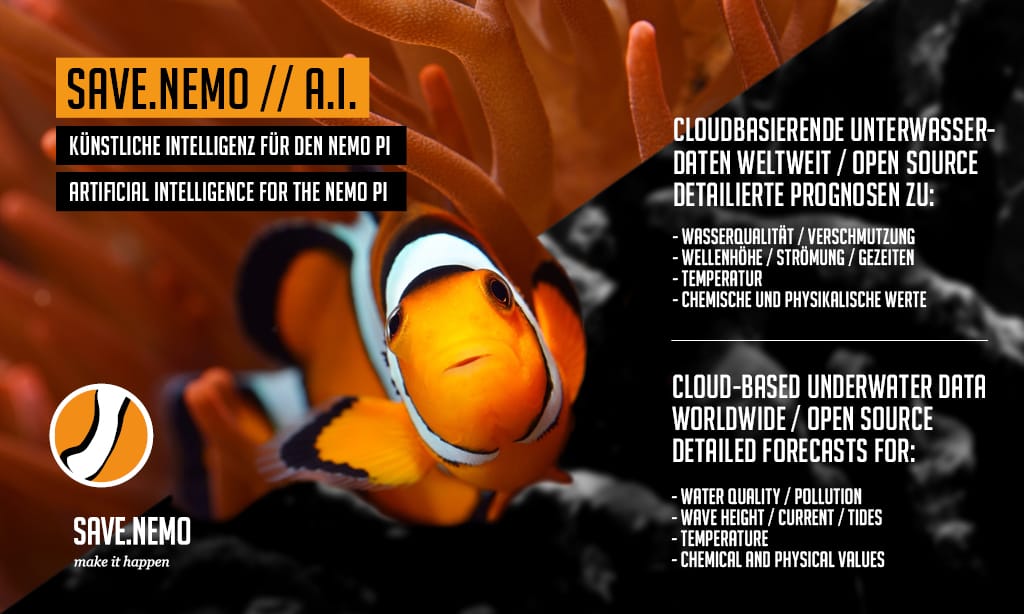
Save Nemo develops an intelligent cloud to combat ocean pollution
Nemo A.I. cloud software uses artificial intelligence to provide reliable ocean forecasting models — task force established.
Press release and update
Herford, Germany — Auckland, New Zealand:
The next step in fighting pollution in oceans, rivers and lakes: animal welfare organisation Save Nemo is developing a globally novel forecasting system, based on data from the already successfully tested Nemo-Pi underwater weather station and data buoy. Using artificial intelligence that learns, it will make predictions about the ecological development and stability of rivers, lakes and seas. The launch of the Nemo A.I. cloud software is planned for 2020/21.
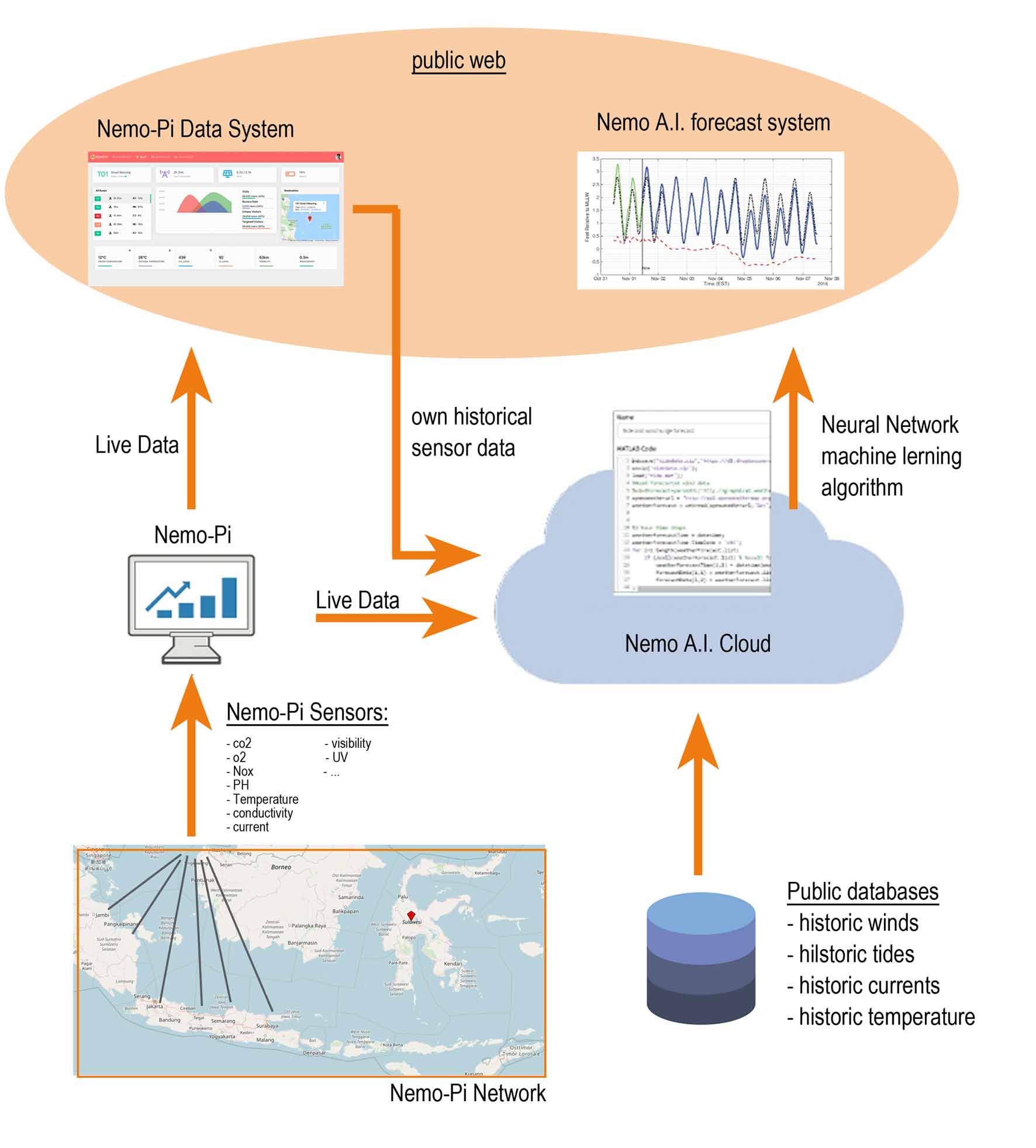
Building on the existing Nemo-Pi underwater weather station, the new Nemo A.I. cloud software is intended to analyse comprehensive data on the physical and chemical properties of bodies of water and produce reliable forecasts of future pollution levels, water temperatures, currents and the amount of suspended matter, including microplastics. In total, the Nemo-Pi's sensors record 19 different chemical and physical values, whose future development is predicted through Nemo A.I.'s self-learning cloud.
Around half a dozen developers, engineers and artificial intelligence specialists working in machine learning are currently researching the feasibility and development of Nemo A.I. within a dedicated task force established six months ago.
They include Olaf Wrieden at Auckland University of Technology, Computer and Information Sciences. “By developing the Nemo A.I. software, we want to bring the forecasting models already used in conventional land-based weather and climate reports to rivers, lakes and seas,” says Wrieden. “Almost three-quarters of our planet is covered by water, and with Nemo A.I. we want to close this important gap,” adds engineer Diemo Niemann, chairman of Save Nemo.
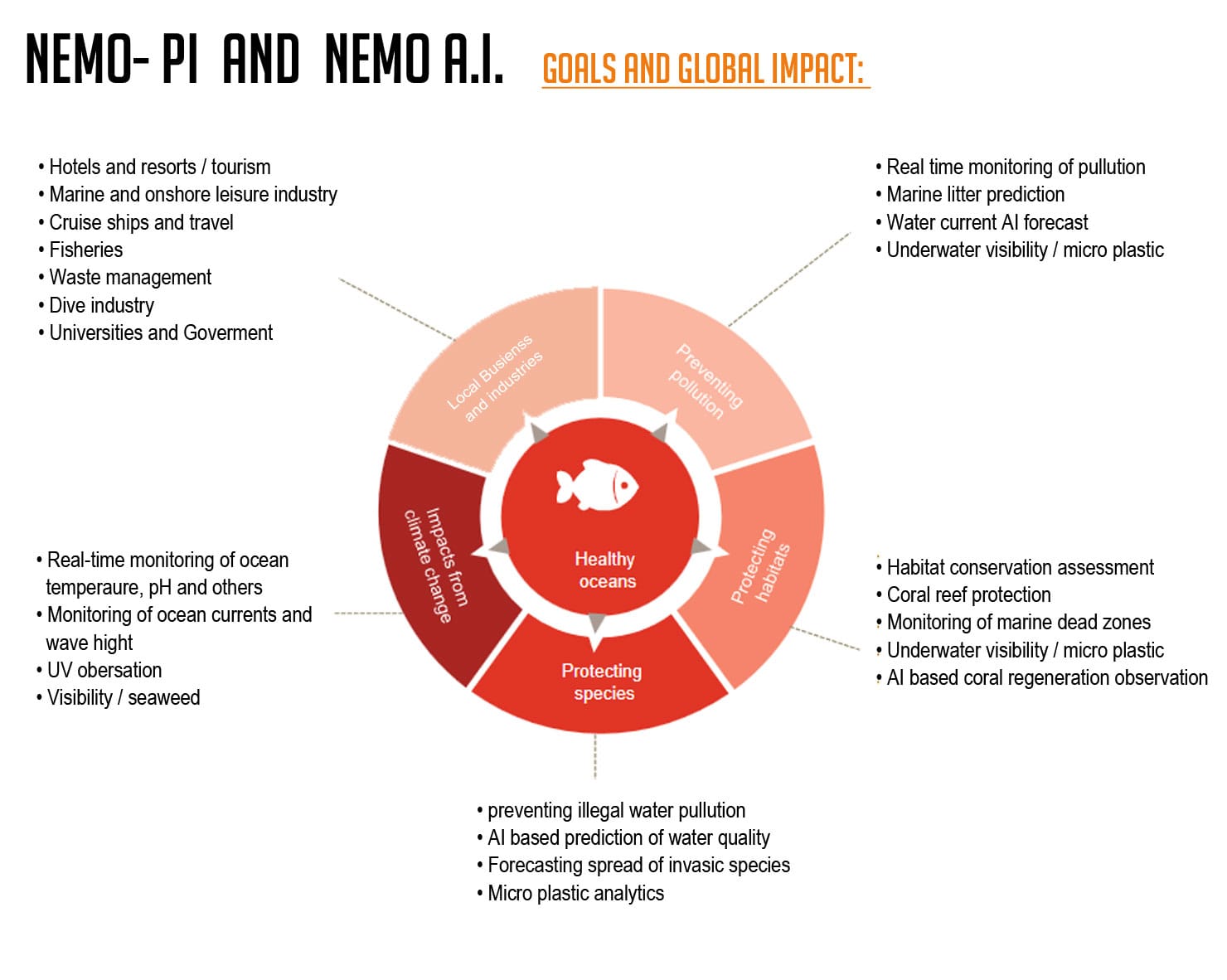
The Nemo A.I. cloud software can be used by fisheries, the waste industry, hotels and the leisure and water sports sector, among others. Its forecasting model allows conditions such as currents, visibility / suspended matter and water temperatures to be predicted reliably over a given period.
“With Nemo A.I., we are creating a new relationship between economic viability, ecology and science,” says lead developer Wrieden.
To create a global network, nonprofit organisation Save Nemo e.V. aims to install hundreds of Nemo-Pi units worldwide over the coming years on moorings it installs itself or that are sponsored. These will then be networked and their data analysed using Nemo A.I. “We also use existing databases containing historical readings,” Niemann adds, “to refine our forecasts.”
Save Nemo's original mission was to prevent anchor damage to reefs caused by diving and snorkelling tourism. Moorings consisting of a concrete block, a chain and a buoy are placed directly beside a reef. Boats can tie up to the buoy rather than dropping an anchor and destroying a section of reef.






The idea emerged several years ago when Diemo Niemann, a passionate diver and PADI Divemaster, saw how quickly healthy reefs could become underwater deserts. Locally produced moorings offer a simple, pragmatic solution.
“The development of the Nemo-Pi, which goes into production in 2019, and the new Nemo A.I. software will make these moorings smart and allow us to gather additional data on the condition of the seas.”
Save Nemo e.V.'s work is financed through volunteer contributions, donations and various licences to use the Nemo-Pi data collected. In future, the new Nemo A.I. forecasting service will also contribute.
Your contribution matters
“We call on the corporations, associations and businesses concerned, as well as universities and private individuals, to provide targeted support for Save Nemo e.V.,” Niemann explains. “Only through joint research, collaboration and sufficient funding can we achieve our nonprofit objective.”
A Nemo-Pi costs between €100 and €600, depending on the number of sensors. By comparison, data buoys such as those used by NOAA — the National Oceanic and Atmospheric Administration in the USA — which are used mainly in science and research and are not available to the general public, cost upwards of around US$50,000.
This makes the Nemo-Pi underwater weather station the least expensive and most advanced of its kind.
As far as is known, the Nemo A.I. cloud is the first scientifically based forecasting platform for the seas.



Originally published in German on 5 February 2019. Read the archived original.